How to Respond to Google Reviews: Templates for Every Situation
Sercan Kahraman
September 13, 2026
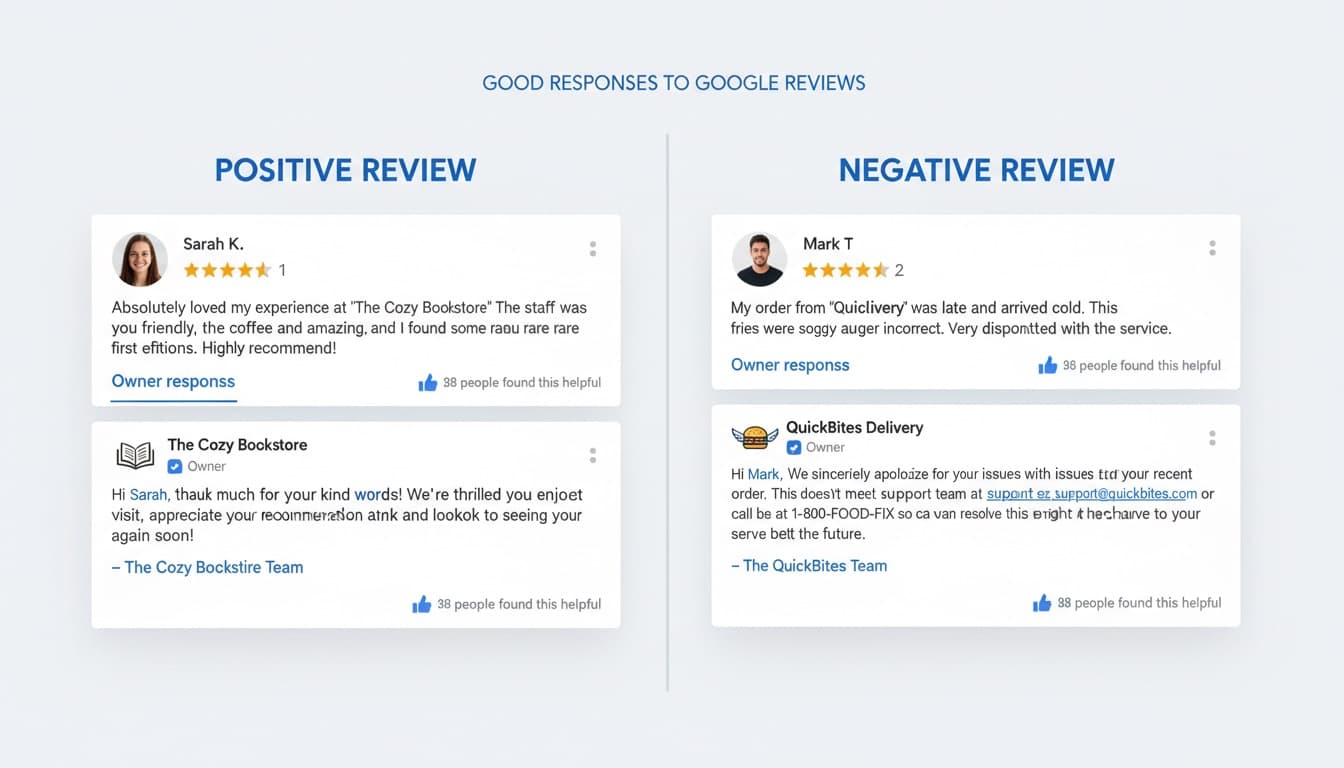
Most guides on this topic start with the happy case. That is backwards. Nobody searches for how to thank someone for five stars at eleven at night. People search after the one-star review lands, and that is the reply that decides what a stranger thinks of the business.
So this starts there.
One thing worth holding on to before the wording: your reply is read far more often by people who were never your customers than by the person who wrote the review. A reply is not a private message conducted in public. It is a sample of how you behave when something goes wrong, published where your next customer will find it.
The one-star review
A reply here does more work than a stretch of good reviews, because it is written under pressure and everyone can see that.
Four parts, in this order:
- Thank them. Even when the wording stings.
- Acknowledge the experience. Where the fault really was yours, say so. Taking responsibility is not the same as pleading guilty to every accusation.
- Show you read it. One specific detail from their review.
- Move it off the platform. A name, a number, an address. The resolution does not belong in the public thread.
Review: “Booked a table for 7:30 for my mother’s birthday. We were seated at 8:20 with no explanation and no apology.”
Reply: “Thank you for telling us, [Name]. Fifty minutes past a confirmed booking is too long, and not explaining the delay made it worse. That is on us. I would like to make it right. Please email [Name] at [email] and we will take care of it.”
Review: “Front desk quoted one figure for the cleaning, the statement showed another. Nobody could explain the difference.”
Reply: “Thank you for raising this, [Name]. A quote at the desk and a statement that do not match is not acceptable, and ‘nobody could explain it’ is the part that bothers me most. Please call [Name] at [phone] so we can pull your file, walk through it with you, and correct it if we got it wrong.”
Review: “Paid for a room with a view. Got a view of the service yard.”
Reply: “Thank you for the feedback, [Name], and I am sorry. If a room was booked and paid for as a view room, that is what should have been waiting for you. Please contact [Name] at [email] with your booking reference so we can put this right.”
Notice what none of these do: argue. The moment you explain in public why the criticism is unfair, a stranger reads a fight, and in a fight the business loses regardless of who is right.
The five-star review
The mistake here is rarely a wrong reply. It is an interchangeable one. “Thanks for the great review!” under twenty entries reads as automation and quietly devalues the reviews themselves.
Pick up whatever the person actually named. One clause is enough.
Review: “Hygienist talked me through every step. First cleaning in years where I was not bracing the whole time.”
Reply: “Thank you, [Name]. Talking patients through each step is something we train for, precisely because so many people arrive braced. Glad it made a difference, and see you at the next visit.”
Review: “Ordered online, picked it up in ten minutes, right size first time.”
Reply: “Thanks for that, [Name]. Getting the size right on the first try is what we aim for, and hearing it worked is good to know. Come find us any time.”
Three sentences are plenty and four is the ceiling. A long reply to a short compliment reads as trying too hard.
The review with no words in it
A large share of reviews are stars and nothing else. They get skipped because there appears to be nothing to answer, which means your reply stands completely on its own.
Four or five stars, no text:
Reply: “Thank you for the rating, [Name]. If you have a moment to say what worked, it helps us keep doing it.”
One to three stars, no text, is the harder case. You do not know what went wrong, so ask without pressing:
Reply: “Thank you for taking the time, [Name]. The rating does not tell us where we fell short. Reach us at [phone or email] with a sentence about what happened and we will look into it.”
That second reply is written almost entirely for the people reading later. It shows that you follow up even when nobody hands you a starting point.
What never goes into a public reply
A reply on Google stays public, indefinitely, readable by people with no connection to the matter.
- Details of the job. No booking references, appointment times, diagnoses, amounts, or addresses. Not even when the reviewer mentioned them first.
- Confirmation that someone was a customer. In some industries that fact alone belongs to nobody else.
- Assumptions about the person. “You were never a customer here” may be accurate and still reads as an attack. It is the fastest route from a review to a story someone shares.
- Compensation. Discounts or vouchers do not belong in a reply. Tied to changing or removing a review, they breach Google’s policies. Untied, they still suggest that reviews are negotiable.
One detail from Google’s own help that surprises people: when you reply on behalf of the business, your personal name is not displayed. The reply appears as the business speaking. If you want it signed, put the name at the end of the text yourself.
How fast, and how often
Within 24 hours is the target and 48 is still fine. For critical reviews, sooner is better, as long as the reply is not written while you are still angry. If you catch yourself defending, leave the draft overnight. A late, level reply beats a fast, sharp one.
Consistency outweighs speed. A profile where the last twenty reviews all carry a reply reads very differently from one where three are answered and seventeen are not, and the gap shows most when the unanswered ones are the critical ones. Twenty minutes twice a week covers it for many businesses.
Templates that do not read like templates
Templates are worth having, otherwise nobody replies reliably. The mistake is choosing the wrong part to fix in advance.
Backwards: the whole text is fixed and only the name changes. Anyone reading two replies in a row spots it.
Right way round: the structure is fixed and the specific detail is new every time. Your template is a frame, not a text:
Thanks + [what the person actually pointed at] + [why that is deliberate, or why it failed this time] + [open door or route off the platform]
That takes a few minutes per reply and still produces no two alike. If a tool drafts replies for you, the same rule holds: the draft is a draft, and the specific detail is the part you check before it goes out.
When more than one person replies
Across several locations or with rotating staff, replying rarely fails on skill. It fails on ownership.
- One person owns the rhythm. Not everyone, or it becomes nobody.
- Decide what ships without review. Replies to four- and five-star ratings should not wait for approval.
- Decide what needs a second pair of eyes. One and two stars, anything touching hygiene, safety, or billing, and anything with a legal edge.
- Write down the boundaries, not the sentences. One page on what must stay out of a reply beats twenty finished phrases.
Frequently asked questions
Do I need to reply to every review?
Reply to every critical one and to every review that gives you something to work with. If you cannot manage all of them, start with the critical and the detailed ones.
What about a review that is clearly false?
Report it first, then reply anyway. How reporting works and what Google treats as a violation is covered in How to Handle Fake or Spam Reviews on Google. Keep the reply factual and free of counter-accusations, because the review stays public until a decision is made.
Can I edit a reply later?
Yes. Replies can be edited and deleted. If you realize a day later that you wrote in anger, that is the moment to fix it.
Should I ask the reviewer to change their rating?
Not in public. If the matter is resolved in conversation, people often revise on their own. Asking for it in the reply reads as pressure, and everyone is reading.
The part worth remembering
Every other line in a review profile is written about you by someone else. The replies are yours. They are worth more than a form letter and more than whatever fits into the last five minutes of a Friday.
Templates, tone, and reply history for every location in one place. Free for 14 days, no credit card.